
Edinburgh office spotlight
Following our move to our new larger office in the heart of Edinburgh , some of our Edinburgh partners lift the lid on their practice areas, experience and the market trends opening up opportunities for their clients.
Caroline Loudon, Licensing Partner

What is your expertise/practice area?
I am a specialist licensing and gambling lawyer and Partner in TLT’s UK wide licensing practice, and I have worked in this area of law for 20 years. Prior to joining TLT, I was “Head of Licensing and Gambling” at my previous firm, Lindsays.
What kind of work have you been undertaking while at TLT?
The client base that I work with is very diverse. Over the last few years, I have help license nearly the whole of the St James Quarter in Edinburgh; assisted Lost Shore Resort with their new surf/resort facility; helped Harrods to open in Glasgow; enjoyed a “licensed” gin sale with the team from Ian MacLeod on the new rooftop at Edinburgh Gin Distillery and at Rosebank in Falkirk and attended the Taylor Swift concerts with increased capacity and hope to so the same later this year at Oasis.
I enjoy working closely with clients such as Scottish Event Campus; Scottish Rugby/Elior at Murrayfield Stadium; The Hibernian Football Club, Aldi, CJ Lang & Sons, Signature Group, Edinburgh University Student’s Association, and Artfarm. These are relationships built over many years.
On the festivals/events side of things we work directly with The Neighbourgood Market Ltd, Edinburgh Cocktail week and have been involved in a variety of pop-up events and festivals all over Scotland.
I continue to support the Scottish Hospitality Group and Scottish Beer and Pub Association, advising on key challenges they face as a sector, whilst also supporting them unlock new opportunities for growth and development. Short Term Let licensing has kept the team busy as has the rise in the more strategic work, contentious applications and strategic and partnership work that I undertake with clients.
What have been some challenges / milestone moments for the market, which you have supported clients through?
We are not supposed to talk about the dreaded Covid years, but businesses in the sector are still facing the fallout from lockdown. Clients are still adapting to new market forces, alongside changes in customer demand and how they spend their money.
The increases in operating costs for the sector, as well as the difficulties with non-domestic rates have created financial challenges which have impacted the market with operators being forced to close.
We have supported our clients by adding permissions, hours and activities to licences to create asset value and additional trading. We have also given strategic advice on new projects to maximise licences, deliver additional value and create opportunities from challenges. We also advise on how businesses can put measures in place to cut costs through licensing.
A client once described me as the "winner of unwinnable licences”. I try to live to that mantra and deliver the unachievable for clients. Broken down and with direct liaison and consultation with partner agencies the “unwinnable” becomes “winnable”.
What’s coming next for the sector in the short term?
Ongoing financial pressures will no doubt continue for the sector, with further legal changes and immigration changes coming from the amendment to the Border Security, Asylum and Immigration Bill. This will mean that employers will be required to carry out checks in relation to their workers, with large civil penalties for non-compliance.
The Terrorism (Protection of Premises) Act known as Martyn’s law, is of immediate interest to all premises/events where the public have access. Businesses and public sector organisations will be required to ensure protection “so far as reasonably practicable” against terrorist attacks for staff and the public. Hospitality, be that entertainment, retail, leisure, sporting premises will be required to risk assess (according to differing tiers) and take proportionate steps to protect those on their property.
As always, clients are having to constantly react to international, social and market trends, with connectivity having such an immediate influence on what is hot, and what is not. Developments in AI in the gaming industry are continuing at pace and will drive new entrants into the Scottish market.
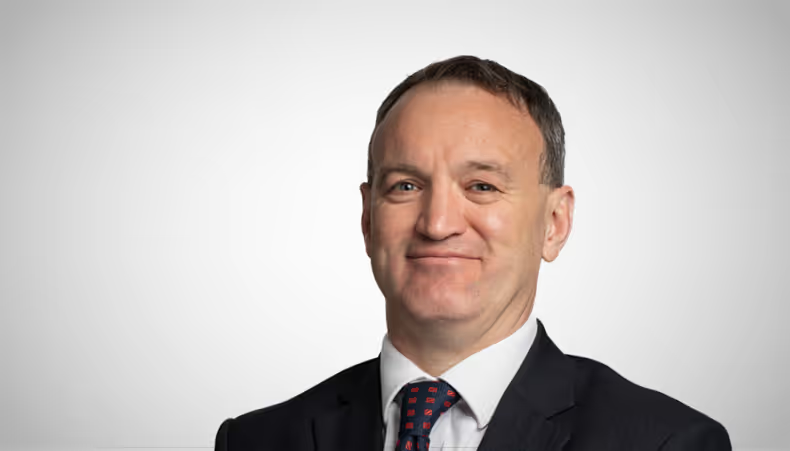
Douglas Roberts, Corporate Partner
What is your expertise/practice area?
I am a specialist in corporate law with a particular focus in Employee Ownership Trusts (EOT) and sports law.
What kind of work have you been undertaking while at TLT?
During my time at TLT, I have been involved in a wide variety of corporate work, including M&A, EOTs, investment rounds and corporate advisory work. I represent a broad spectrum of clients including SMEs, family businesses and start-ups and provide a client-focused dealmaking approach.
I have helped clients throughout the UK with numerous transitions to employee ownership. I also regularly advise employee-owned businesses on an ongoing basis including with reorganisations, acquisitions and sales.
Alongside my EOT expertise, I am also a specialist in sports law, and have acted for a number of sports clubs, governing bodies and individuals, including successfully representing clients in one of the highest profile sports law disputes in Scotland this century.
What have been some challenges / milestone moments for the market, which you have supported clients through?
In October 2024, the government introduced several changes to EOTs as part of the 2024 Autumn Budget aimed at making the rules more robust and ensuring EOTs are used for their intended purpose, whilst also retaining EOTs as an appealing alternative succession planning strategy.
The combination of a challenging M&A market throughout 2024, as a result of high interest rates, the rise in capital gains tax, and changes in EOT rules, drove an increase in interest for the EOT model in Scotland. To my recollection, October was one of the busiest months I have experienced in my career for M&A activity.
From a TLT perspective, we completed six sales in seven working days, which is not only a clear indicator of a healthy M&A market, but also a testament to our position as leading advisors to the sector.
What are the core themes and trends shaping the sector for the next financial year?
EOTs remain very popular. We are currently working on EOT deals in Scotland, England, Wales and Northern Ireland, demonstrating the strong appetite and interest from businesses across different sectors to transition to an employee ownership model.
This trend is partly due to the rise in ESG concerns and reflects the increasing thought that business founders are giving to securing the legacy of their businesses. EOTs allow owners/founders to protect their unique culture, values and processes that have often been passed down through generations, as well as offering a ‘soft’ exit, allowing them to step back gradually, rather than making an abrupt departure.
Giving employees the opportunity to own shares in the business can also increase engagement and help staff feel empowered to take part in decisions that matter to them. Some of the EOT deals we have worked on have been very emotional for our clients and their staff. It is very fulfilling to hear stories from clients on how their employees are grasping the opportunity to have a say in their futures.
We are also seeing EOTs mature, with more funders lending for sales to trusts and EOTs selling companies (with substantial payments to employees).
Sadly, there is also a lot of lingering uncertainty in the M&A market. There are a number of ongoing developments disrupting the market such as tariffs and tax rises, and which are naturally causing clients to carefully consider their next move.

Get in touch
Related services
Get in touch
Insights & events

