
The countdown to DMCC-day
Are you prepared for the UK's consumer law enforcement 'reset'?
This year will mark a major shift for the UK’s consumer law framework, with Parts 3 and 4 of the Digital Markets, Competition and Consumers (DMCC) Act due to come into force in April 2025.
This builds on Parts 1 and 2 of the DMCC Act, introducing the CMA’s new digital markets and competition enforcement powers, which are now live – having come into force on 1 January 2025. For more information on those changes, read our Digital Markets and Competition law DMCC In Focus guides.
Need a recap? The key consumer protection changes of the DMCC Act
For a comprehensive overview of the changes under Parts 3 and 4 of the DMCC Act, you can read our DMCC in Focus Consumer Protection Guide. But in summary, the changes are two-fold:
- Enforcement risk (penalties). Under Part 3 of the Act, the CMA will be given new direct consumer enforcement powers, including the power to impose civil penalties of up to 10% of global turnover on businesses that breach UK consumer protection laws without going to court.
- Changes to substantive consumer law. Part 4 of the Act overhauls existing consumer protection legislation for unfair commercial practices, with the Consumer Protection from Unfair Trading (CPUT) Regulations 2008 repealed, reformulated and recast as primary legislation. In doing so, the CMA has made a number of substantive changes to consumer law (see below). This further widens the UK/EU regulatory divergence post-Brexit, with the equivalent EU regime for unfair commercial practices updated on the EU-side through the Omnibus Directive in January 2021.
Note that Part 4 of the Act also introduces a new regime governing B2C subscription contracts. Those new rules (which we reported on here) aren’t expected to come into force until Spring 2026 and require secondary legislation. The new subscription contracts rules are the subject of an ongoing DBT consultation.
Unfair Commercial Practices (UCPs)
First, an important reminder: the CMA’s new enforcement powers don’t just apply to the consumer law contained within Part 4 of the DMCC Act. They also cover a wide range of consumer protection legislation, including the Consumer Rights Act 2015 and Consumer Contracts Regulations 2013. [1]
That said, UCPs are likely to feature prominently in CMA enforcement after Spring 2025. These are the principle-based rules that the CMA (and certain other regulators) rely on to take action against commercial practices that they broadly consider to be ‘unfair’.
The reformulated UCP test under Part 4 of the DMCC Act is as follows:
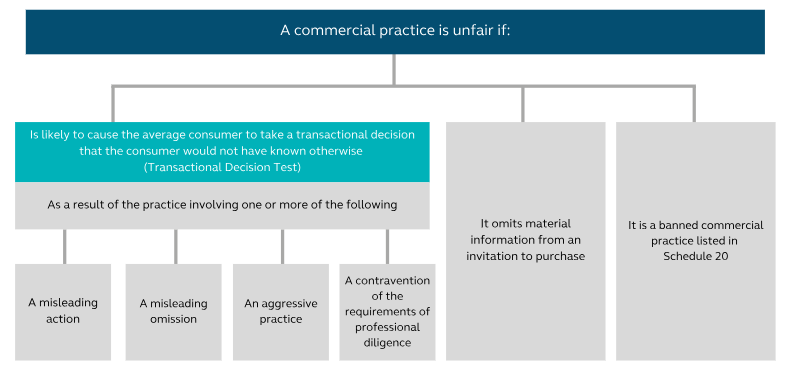
Many businesses will already be familiar with the concepts of ‘misleading actions’ and ‘misleading omissions’ but perhaps less familiar with the ‘professional diligence’ requirement. This broadly considers whether the commercial practice “…falls short of the standard of skill and care which a trader may reasonably be expected to exercise towards consumers which is commensurate with either— (a) honest market practice in the trader’s field of activity, or (b) the general principle of good faith in the trader’s field of activity.”
It's very important that businesses understand the wide scope of this requirement. Unlike misleading actions and omissions, it goes further than the content of consumer-facing statements (e.g. advertising) and allows enforcers to examine ‘behind the scenes’ of commercial practices that have an adverse impact on consumer behaviour.
The professional diligence requirement has been central to a number of CMA consumer enforcement cases in recent years. For example, it was the basis on which the CMA required fashion retailers to implement supplier due diligence measures in the undertakings that followed its misleading environmental claims investigation in the retail fashion sector. It is also at the heart of consumer law obligations that apply to digital platforms and online marketplaces, and underpinned the CMA’s enforcement action into online car rental intermediaries.
The DMCC Act reforms the professional diligence test to make it easier for the CMA to enforce – see further below.
CMA draft guidance on UCPs
On 11 December 2024 the CMA published its much-anticipated draft UCP guidance document (the UCP Guidance) that will inform its enforcement of Part 4 of the DMCC Act. The UCP Guidance is 109 pages long and (finally) replaces the OFT guidance that accompanied the launch of the CPUT Regulations back in 2008. Needless to say, commercial practices in the digital economy have moved on since then, and this is the first time the CMA has published its own comprehensive guidance on UCPs.
It also provides much-needed guidance on the wide scope of UCPs, including the professional diligence requirement. The UCP Guidance reiterates the position that B2B practices may also be caught if they relate to the promotion or supply of products to consumers – for example product claims (including green claims) made by manufacturers that could be repeated by retailers.
The draft UCP Guidance is therefore essential reading for businesses looking to tighten-up on consumer law compliance before April 2025.
In addition to covering UCPs that are unchanged by the DMCC Act, the UCP Guidance also provides some much-needed practical guidance on some of the ‘new’ consumer law requirements in the DMCC Act. In particular:
- Drip pricing. As the UCP infographic above shows, omitting ‘material information’ from an invitation to purchase is now a strict liability offence under s230(2)(b) of the DMCC Act (akin to a ‘banned practice’). There is no need for enforcers to demonstrate that the failure would have an impact on the transactional decision making of the average consumer. Crucially, this now also includes the failure to provide the “total” price of a product in an invitation to purchase. The UCP Guidance sets out the CMA’s expectation on how it expects business to comply with this requirement in practice, including in relation to common mandatory charges such as delivery fees – as well as so-called ‘junk’ fees such as administration and booking fees. Notably, the CMA’s position is that all mandatory charges must be included in a single (total) headline price; it does not appear to permit different elements of the price (e.g. core price + delivery charge) to be segmented within the headline price unless a cumulative ‘total’ is also provided. Mandatory charges that cannot reasonably be calculated in advance don’t need to be included in the headline price, but businesses must prominently set out how they will be calculated. The UCP Guidance also provides further detail on the difference between ‘mandatory’ and ‘optional’ charges. There is no requirement to include genuinely optional charges or ‘add-ons’ in the headline price.
- Consumer reviews. The DMCC Act contains a new ‘banned’ practice in relation to fake or misleading consumer reviews under Schedule 20(13). Businesses should be aware that these rules go much further than prohibiting outright ‘fake’ reviews; they effectively introduce a self-contained micro-regulatory regime governing consumer reviews – including concealed incentivised reviews and “consumer review information” (e.g. displaying total review scores, star ratings and rankings informed by consumer reviews). These obligations are proactive in nature – with an emphasis on businesses taking ‘reasonable and proportionate’ steps to prevent and remove misleading consumer reviews. This is underpinned by 20 pages of detailed guidance in Annex B of the UCP Guidance. The CMA has also provided infographics to help businesses navigate this new regime, which we have reproduced below:
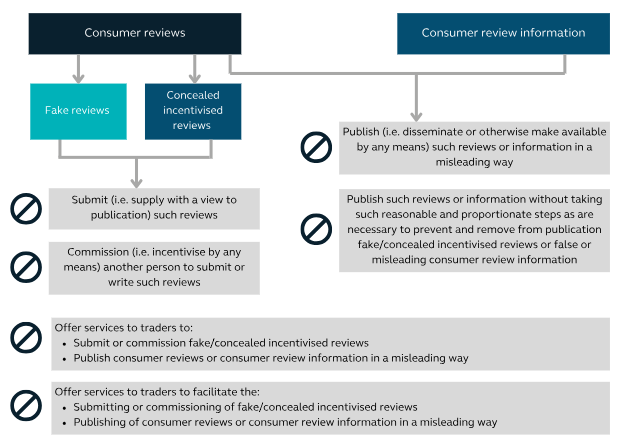
Figure 1: CMA overview of the banned practice related to consumer reviews and consumer review information.
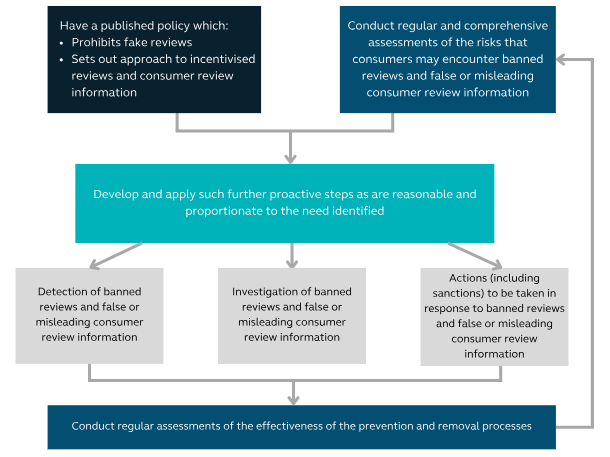
Figure 2: CMA overview of the general steps required of publishers of consumer reviews or consumer review information.
Annex C to the UCP Guidance provides a detailed overview of the changes made to the CPUT Regulations under Part 4 of the DMCC Act.
Many of these changes are subtle and technical in nature, but fundamentally they are designed to remove drafting that the government (and CMA) see as superfluous or unnecessary. This should make the rules easier for the CMA to enforce. Crucially, the changes mark a clear fork in the road in terms of regulatory divergence post-Brexit as the CPUT Regulations were introduced to implement the old EU Unfair Commercial Practices Directive. With the Omnibus Directive also making changes to the EU regime for UCPs back in 2021, the ‘gap’ between EU and UK consumer law continues to widen.
Some of the most significant changes include the following:
The DMCC Act introduces the concept of ‘situational vulnerability’. Consumers can now be considered vulnerable due to a wide range of life circumstances such as mourning, divorce or job loss, in addition to the established forms of vulnerability such as age or physical and mental health. This broadens the scope beyond traditional factors, allowing for a more inclusive understanding of vulnerability.
The professional diligence requirement has been substantively modified in two ways, both of which are designed to simplify enforcement. This reflects the likelihood that the CMA will rely on these provisions to target a wide-range of behavioural UCPs under the new enforcement regime:
- First, the standard of skill and care traders are required to meet is no longer defined as a ‘special’ standard of skill and care (the word ‘special’ has been deleted) – which is a lower and simpler standard for the CMA to satisfy.
- Second, the transactional decision test for the professional diligence requirement has been brought in line with other UCPs. Specifically, it removes the condition that a professional diligence failure must ‘materially distort or be likely to materially distort the economic behaviour of the average consumer with regard to the product’. As with other UCPs, the transactional decision test will be satisfied if the failure would be ‘likely to cause the average consumer to take a transactional decision that the consumer would not have taken otherwise’. This removes the need for the CMA to satisfy different statutory tests for different types of UCP and is designed to make enforcement easier for the CMA going forwards (noting that appeals of CMA penalties are very likely to generate complex case law on the ‘transactional decision test’ in the future).
As noted above, the DMCC Act removes the transactional decision test entirely from the offence of ‘omitting material information from an invitation to purchase’ – effectively making it a ‘strict liability’ offence. While this change has primarily been made to help the CMA combat drip pricing (see above), it is important to note that s230(2) of the DMCC Act sets out a list of information that is considered ‘material’ for the purposes of an invitation to purchase – for example the main characteristics of the product and identity and business address of the trader (unless already apparent from the context). This is particularly relevant for the information provided in B2C marketing material. Section 230(8) does, however, permit some flexibility for constraints afforded by time and space (and steps taken by the trader to overcome those limitations by providing information by other means).
In a subtle (but potentially significant) change, the DMCC Act removes the word ‘very’ from the previous banned practice in relation to time limited product statements. See below:
“Falsely stating that a product will only be available for a very limited time, or that it will only be available on particular terms for a very limited time, in order to elicit an immediate decision and deprive consumers of sufficient opportunity or time to make an informed choice.”
This is designed to help the CMA combat misleading scarcity or urgency claims by lowering the statutory test for what constitutes a ‘limited time’. As seen in its recent enforcement against Wowcher, Emma Sleep and Simba Sleep, urgency and scarcity claims are a form of ‘dark pattern’ that the CMA has viewed as an enforcement priority.
When will Parts 3 and 4 of the DMCC Act take effect?
DBT has informally said that it expects Parts 3 and 4 of the DMCC Act to come into force on 6 April 2025 – although the precise date is yet to be officially confirmed. The commencement order required to enact the changes will be made at least 28 days before the commencement date.
There is no formal grace period for businesses. While the CMA will not use its new enforcement powers under Part 3 of the DMCC Act to enforce against UCPs that ceased before the commencement date, the CMA can impose penalties in relation to ‘continuing infringements’ that are ongoing when its new powers come into force.
The lack of any formal grace period reflects the CMA’s position that the substantive changes made in Part 4 of the DMCC Act essentially codify its interpretation of the existing principle-based requirements under the CPUT Regulations. While this perhaps overestimates most businesses’ awareness of previous CMA sector-specific enforcement (most of which has not been tested by the courts due to the tendency for investigations to be resolved informally via undertakings) the fact remains that businesses don’t have much time to prepare for new consumer law requirements – particularly as the UCP Guidance is unlikely to be finalised until around the time that Part 4 of the DMCC Act comes into force.
What do I need to do to prepare?
Our consumer law risk mapping tool can help you get a better understanding of how well prepared you are for the upcoming consumer law changes.
Preparing for the substantive changes highlighted above is crucial – but it’s also important for businesses to view the changes holistically. For example:
- The CMA is likely to maintain its focus on misleading environmental claims, price promotions and online choice architecture (dark patterns). The underlying consumer law principles in those areas are largely unchanged by the DMCC Act – the key differential in the new DMCC era is that the risk of penalties for non-compliance will increase exponentially.
- As noted above, the UK consumer protection framework isn’t just about UCPs. It’s also important that businesses focus on consumers’ statutory rights and remedies under the Consumer Rights Act 2015 and Consumer Contract Regulations 2013.
- More generally, the CMA’s recent consumer enforcement case against Wowcher (as reported here) provides a good example of the often complex and involved nature of consumer law compliance – particularly for digital platforms. In addition to the focus on misleading countdown clocks, scarcity and popularity claims, Wowcher was also required to implement user interface changes designed to facilitate consumers’ ability to exercise their statutory rights, as well as providing greater clarity around who consumers are contracting with.
We encourage all consumer-facing businesses to take a fresh look at their consumer law compliance policies and procedures in the coming months. Targeted, thematic audits are also strongly encouraged to help identify and remove any potential non-compliant UCPs before April 2025.
The best way to manage the risk going forward is to embed a culture of ‘compliance by design’ – particularly for digital platforms and online retail. The CMA’s draft consumer enforcement guidance (published in July 2024) highlights the importance of staff training and consumer law compliance policies. Businesses that fail to proactively manage consumer law compliance could face an uplift in penalties under the CMA’s draft penalty calculation guidelines.
__
[1] See Schedule 16 of the DMCC Act for a full list of regulations subject to the CMA’s new direct enforcement powers.
This publication is intended for general guidance and represents our understanding of the relevant law and practice as at January 2025. Specific advice should be sought for specific cases. For more information see our terms & conditions.


Get in touch

%20%C3%94%C3%87%C3%B4%20790px%20X%20451px%2072ppi9.jpg)


%20%C3%94%C3%87%C3%B4%20790px%20X%20451px%2072ppi34.jpg)
%20790px%20X%20451px%2072ppi.avif)






Related services
Insights & events

The Electronic Communications Code in court: Five lessons operators should be acting on now

Fair play for gamers: CPC Network takes enforcement action on in-game virtual currencies

The Electronic Communications Code: Building a resilient telecoms portfolio

EU KIDS Act: Europe's plan to strengthen child online safety

The Electronic Communications Code: Key considerations for public bodies

Why CAP Code Rule 1.3 matters: Social responsibility in advertising

Export control enforcement: Lessons from the Airbus settlement

Reflective loss won't save rogue directors: What minority shareholders need to know

Developing land with telecoms apparatus: How the Electronic Communications Code can impact project delivery
The Electronic Communications Code: Key landowner rights and operator risks

DMCC Act subscription contracts regime brought forward by the PM: What do businesses need to know?
The Electronic Communications Code: What you need to know

Using contractual levers to manage supplier performance: Tips and pitfalls

DMCCA penalty #2: CMA fines Marks Electrical for use of automatic opt-ins for additional charges

AI in Motion: Balanced algorithms - addressing bias in AI

UK tech sovereignty: Insights from London Tech Week 2026


Retail Agility: Navigating the AI frontier in retail




The Franchise Act in the Netherlands - how will it affect you?

The fast and the curious: Empowering in-house lawyers to create business value



European Access Plan: Your gateway to business in the EU

Rebalancing act: the impact of retail transformation on people and stores

How competitors can work together to protect the economy and consumers from the coronavirus crisis




TLT supercharges innovation and tech offering with strategic partner hire

TLT assists pioneering clinical-stage diagnostics company on investment

Court of Appeal upholds CMA charge control for blue-light radio network services
TLT advises K3 Capital Group on acquisition of HMA Tax Limited


TLT continues expansion of future energy team with appointment of regulatory expert

TLT highly commended at FT Innovative Lawyers Awards Europe
TLT shortlisted for two awards at The Lawyer Awards 2023

TLT shortlisted for two awards at Manchester Legal Awards

TLT advises shareholders of Insight Legal on sale of cloud-based software company

TLT boosts UK-wide commercial offering with appointment of senior hires

TLT Grows National Regulatory Team | TLT

TLT expands its commercial services group with new disputes hires

TLT Targets Northern Ireland Growth with Senior Hire | TLT
TLT Partner Appointed Chair of North West Fraud Forum | TLT


Scale up Insights episode five - grow and manage your team

DMCC Act subscription contract rules: Everything you need to know

International Fintech Case Study: Brexit Contract Migration | TLT





Document automation for in-house legal teams | Contract management

