Infrastructure Planning Blog
34: Data centres can be NSIPs after a record DCO year
This week's entry covers data centres becoming nationally significant infrastructure projects (NSIPs) and other Planning Act 2008 related news.
Data centres become NSIPs
Data centres have become potential NSIPs as of 8 January 2026 thanks to a statutory instrument.
I say 'potential' because they are not compulsory project types that must use the regime but can opt into it. This is of course in the context that soon nothing will be absolutely compulsory as it will be possible to apply to opt out of the regime once section 4 of the Planning and Infrastructure Act 2025 is brought into force.
This has been achieved simply by adding 'Data centres' to the list of business and commercial projects that are able to opt into the Planning Act 2008 regime if they are considered nationally significant.
'Data centres' are not defined, but back in September 2024 technology minister Peter Kyle MP declared data centres to be 'critical national infrastructure' for the purposes of national resilience. The press release describes data centres as 'the buildings which store much of the data generated in the UK'. Note that this is not the same as the 'critical national priority' designation for some energy NSIPs.
You might think data centre size would be measured in bytes with some huge metric prefix, like quettabytes, but in fact they are generally measured in megawatts (MW), because the size of the electricity supply is the critical factor that determines their capacity. The largest data centre in the UK currently is probably the Virtus London5 centre in Slough, which is 90MW, but larger ones are under development and the situation is quite dynamic.
Contracts for difference allocation round 7 results
The results of the seventh ‘contracts for difference’ allocation round were announced this week. This is where renewable energy suppliers get the difference between the price they sell electricity for and the declared ‘strike price’ from the government-owned Low Carbon Contracts Company, to give them sufficient certainty and predictability to develop their projects.
All projects on the list are offshore wind farms, including the decided DCOs Awel y Mor and Norfolk Vanguard and the awaiting decision Dogger Bank South, all at a strike price of £91.20 per megawatt hour.
Record year for DCOs
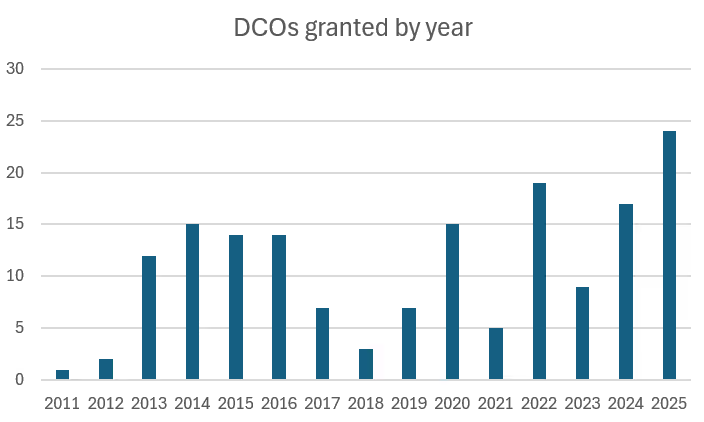
2025 was a record year for granted Development Consent Orders (DCOs), with 24 being given consent – the previous record was 19 in 2022. It’s still a bit short of the average 30 per year needed to hit the 150 by the next election target, but encouraging nonetheless.
There was a wide variety of consents (probably the widest so far): two airports, two energy from waste, one gas-fired power station, five offshore windfarms, seven solar farms, one harbour, four highways, one ‘other’ (i.e. non natural gas) pipeline and one waste water project. A collective pat on the back to the infrastructure planning sector!
The cloned examining authority
Finally, I was intrigued by this week's Rule 6 letter for the 180km Norwich to Tilbury overhead line application, since two days after the preliminary meeting there is an open floor hearing at 10am in Orsett, Essex and another one at 11am in Norwich. Will the ExA split themselves with some attending each, all attend virtually or create avatars like Abba Voyage? Time will tell.
This publication is intended for general guidance and represents our understanding of the relevant law and practice as at January 2026. Specific advice should be sought for specific cases. For more information see our terms & conditions.


Get in touch

%20%C3%94%C3%87%C3%B4%20790px%20X%20451px%2072ppi%20MANCHESTER5.jpg)

%20%C3%94%C3%87%C3%B4%20790px%20X%20451px%2072ppi2.avif)
%20790px%20X%20451px%2072ppi.jpg)

%20%C3%94%C3%87%C3%B4%20790px%20X%20451px%2072ppi2.jpg)





Related services
Get in touch


Insights & events

Infrastructure Planning Blog 73: Regulating regulators

Infrastructure Planning Blog 72: Latest solar DCO decision analysed

Belong v Seddon: Can PCSA liabilities survive following execution of a JCT contract?

Northern Ireland Planning and Environment update: Energy


Infrastructure Planning Blog 70: Statistics on major projects, tech updates, and applying the new NPPF

Infrastructure Planning Blog 69: Application stocktake as changes to the Planning Act 2008 regime start to take effect

Infrastructure Planning Blog 68: Morecambe and a wise decision?

Adjudication Enforcement in Focus: When is an Agreement Agreed?

Infrastructure Planning Blog 67: Put out more flags

Infrastructure Planning Blog 66: Full BNG for NSIPs guidance published

Infrastructure Planning Blog 65: A beacon of light

Infrastructure Planning Blog 64: What does the updated National Planning Policy Framework mean for infrastructure?

Infrastructure Planning Blog 63: Harry Potter and the grave error

Infrastructure Planning Blog 62: The end of the challenges to expansion of Luton and Gatwick Airports

Infrastructure Planning Blog 61: More updates to PINS' advice




Impact of flexible working on towns and cities - the market and legal considerations

1 September – all change (again) for the Community Infrastructure Levy



Nick Evans joins TLT as partner placing the firm at the helm of infrastructure, planning, public law and future energy in the UK

TLT expands future energy and infrastructure expertise with new Partner appointment

TLT strengthens public sector infrastructure and future energy offering with two new partners

TLT strengthens construction expertise with third partner hire in six months
TLT adds 29 lawyers creating one of the largest practices of its kind in the UK

TLT grows projects infrastructure and construction team with appointment of new partner
TLT hires transport and renewable energy specialist supporting the expansion of its planning team

TLT Partner Appointed Chair of North West Fraud Forum | TLT

TLT Shortlisted for Firm of the Year at Scottish Legal Awards | TLT

TLT Wins Law Firm of the Year at Manchester Legal Awards | TLT

TLT Recognised for Two Awards at The Lawyer Awards 2022 | TLT

TLT Shortlisted for Two Manchester Legal Awards 2022 | TLT

TLT advises Network Homes on £140m sale to Grainger

TLT advises One Housing Group on major affordable housing project

TLT advises Town and Country Housing on modular homes acquisition



Preparing for the Procurement Act 2023 - construction industry focus

BNG - TLT and Belmont Estate talk nature positivity

What does the next generation of our cities look like?
Issues and trends driving the shape of our cities: expert view from Savills & TLT