
ESG in Action: Beyond returns: Inside the world of responsible investment
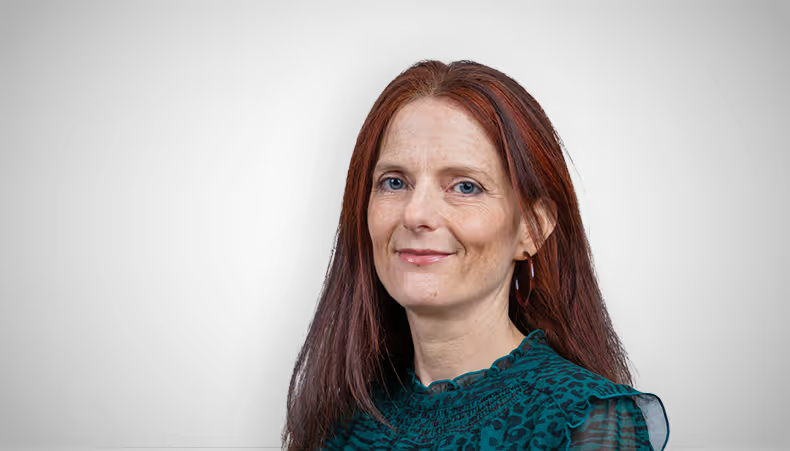
In this episode of ESG in Action, we’re examining the world of responsible investment with Jaid Longmore, Responsible Investment Manager at Hymans Robertson.
TLT host Alex Holsgrove Jones talks to Jaid about how Hymans helps its clients to build better financial futures, while staying abreast of sustainability policy and making a meaningful impact for clients, colleagues, and wider society.
In this conversation, they’ll discuss:
- What life is like as a Responsible Investment Manager
- The ‘ABCs’ of responsible investment
- The B Corp movement and what Hymans has learned from it
- The importance of building resilient portfolios
Listen to the episode below, or on your favourite podcast platform, including Spotify and Apple Podcasts – where you can subscribe to make sure you don’t miss an episode.
Jaid Longmore (00:02)
The fiduciaries must consider all risks, including ESG risks, when they're financially material and then stewardship can be seen as a core tool to manage some of those long-term ESG risks and opportunities and it also then therefore forms part of that overall fiduciary responsibility.
Alex Holsgrove Jones (00:22)
Welcome to ESG in Action. I’m Alex Holsgrove Jones, Knowledge partner and ESG lead for TLT, and we’re exploring how values-driven leadership, sustainable thinking and inclusive culture are transforming the business landscape. Each episode, I’m joined by a guest who drives ESG progress – from charity leaders to household brands – and they’ll be sharing the tangible impacts of ESG-led decision making.
I’m delighted to be joined today by Jaid Longmore. Jaid is a Responsible Investment Manager at Hymans Robertson—an independent consultancy working across pensions, investments and insurance. Their purpose is simple but ambitious: to build better futures. That means helping clients navigate complex financial decisions that genuinely affect people’s lives, and doing so with a clear focus on long term outcomes. They’re also a proud B Corp, part of a global community of purpose-driven organisations striving for positive change—aiming to make a meaningful impact for clients, colleagues and wider society.
Jaid, thank you for joining us – it’s great to have you on the show.
Jaid Longmore (01:30)
Thank you very much for having me. I'm very happy to be here.
Alex Holsgrove Jones (01:34)
So, before we delve into Hymans Robertson, can you tell our listeners what it means to be a responsible investment manager?
Jaid Longmore (01:43)
Sure, it's a great question as there's a lot that responsible investments, or RI as I'll probably refer to it from here on, encompasses, and it can seem like an incredibly broad topic. So primarily my role is about advising clients and as you mentioned, they're predominantly pension schemes and funds and advising them on responsible investment topics. So that can range from helping them set RI beliefs, designing and implementing RI policies and then integrating some RI considerations, which we'll probably go into a bit later into the investment strategies and then also supporting them and understanding monitoring and reporting on ESG and climate risks and opportunities across their portfolios. So, to do this, I sit in our investment research team as I sure you can imagine there's a lot of research that needs to go into this and my focus is really on sustainable or climate investment strategies. And then I'm also a part of our stewardship team. So just to give a quick definition on stewardship, it's seen or the FRC defines it as the responsible allocation, management and oversight of capital to create long-term sustainable value. So, there is a lot that it encompasses, but yeah, it all fits together when you're doing the role and everything's kind of interwoven.
Alex Holsgrove Jones (03:13)
Yeah, it sounds like a huge but really interesting role. So now we've got a clear picture of what responsible investment looks like. Let's bring this to life by talking a little bit about Hymans Robertson itself, a business with a long history and a strong purpose. So, Hymans Robertson has been around for over 100 years. What motivated you to take the step to become a B Corp?
Jaid Longmore (03:39)
So, the B Corp movement is about improving the global economy to the benefit of people, communities, and the environment and that's a goal that's always been close to us at Hymans and close to our own purpose, which is together building better futures and that purpose really does sit at the heart of everything we do as a firm. So, we're really creating better financial futures for people in the UK through our services and we've also always worked to ensure that the impact that we have on our own employees and people, our clients, their pension scheme members, and the environment is a positive one. So, B Corp is really a close fit to what we've always cared about. We became B Corp certified in 2023, and that was really to formally acknowledge that commitment to those key areas and I think becoming a B Corp helps us maintain that focus over the long term. It's really that accountability element and then also just to learn from other B Corps. We've hosted events in our offices inviting other B Corps in to kind of learn and then share our own experiences to help them.
Alex Holsgrove Jones (04:50)
So there's a clear alignment between what were already your values at Hymans and your purpose of building better futures together and the B Corp status.
I mean, there has been some talk in the press about B Corps and whether it's just a badge on the wall or whether it's something more meaningful. Can you just give us a picture of how it actually influences the way you work with clients and make decisions?
Jaid Longmore (05:18)
Yeah, absolutely. So, as I mentioned, our services, what our services do is they provide better financial futures for people across the UK. So, to give a direct example and maybe make it a bit more tangible, and hopefully further highlight what a responsible investment consultant does, we help pension plans invest responsibly, right? So, our responsible investments approach focuses around three key pillars. And we like to think of those as the ABCs.
So that's achieving net zero, which is helping clients think proactively about addressing some of the challenges and opportunities related to climate change.
Being better stewards is that B. So that refers back to stewardship that I mentioned earlier and helping clients steward their assets responsibly and sustainably.
And then finally creating positive impacts. And that's through the allocation of capital or through their stewardship efforts, like I've mentioned.
And those ABCs of responsible investments, they really do guide our day-to-day, not only advice to clients, but also how we allocate our time to research and understanding and then they also define the outcomes that we want to achieve and how we want to be judged. So for the outside world, how they can think about whether we're doing our job well.
Alex Holsgrove Jones (06:42)
So, there's accountability there as well, isn't there? And those ABCs of responsible investments are like a great framework. You've mentioned helping pension plans invest responsibly, which is going to touch millions of people's futures. So maybe we can unpack that a little bit. For organisations, what does responsible investment look like in practice?
Jaid Longmore (07:05)
Yeah, great. So responsible investment refers to investment practices that integrates environmental, social and governance. So that's ESG factors into the investment decision making and the ownership activities to improve long term risk adjusted returns and also contributes to sustainable economic, environmental and societal outcomes. So that's quite a mouthful, but you can really think about it and kind of there’s two core dimensions to what I've just said. There's one is the sustainable investment piece. So integrating ESG into investment decision-making. Or also it could mean targeting a specific sustainable outcome alongside a financial outcome through your capital allocation decisions. So that's the ESG integration piece or sustainable investment piece. And then that second piece, I've kind of brought it up a few times, but it's that effective stewardship elements. And that's really about using the rights and responsibilities that come with asset ownership to influence outcomes and you can do that either through voting where it's applicable, so in equities, and also through direct engagement with company management, or if, for example, you maybe own infrastructure assets, engaging directly with investees.
Alex Holsgrove Jones (08:31)
So it's clear that lots of people have a part to play in this and it's really useful to split it out and say, you know, we've got the sustainable investment on the one hand, that's integrating ESG into decisions and then the effective stewardship on the other using ownership rights to influence outcomes. Now, investors have fiduciary duties. How did those responsibilities shape decisions on ESG?
Jaid Longmore (08:57)
Great. So firstly, just to maybe clear up a bit of terminology, I know we've discussed the ESG quite a bit, but ESG factors, as I mentioned, refer to environmental, social and governance factors. So, to bring this to life with some examples, environmental factors could include things like climate change, biodiversity, water stress, resource scarcity. If you think about social factors, that might include things like working conditions, health and safety, data protection rights, finally, governance factors are things like board structure, executive remuneration, shareholder rights. So, these examples aren't exhaustive, but I've mentioned them more to show you that there's a lot of different things that they can encompass. And the important thing to bear in mind is that not all of these factors will be relevant to all investments or to all assets or companies. For example, climate change might be much more relevant to an organisation maybe involved in oil and gas, or let’s say a technology company, although you can argue that it is still relevant for tech companies. If you think about social factors, things like working practices are going to be really important to clothing manufacturers as they might have diverse supply chains across multiple geographies and the main point here is that materiality. So, all of those factors have the ability to influence investor outcomes in some way.
The question is how significant that is likely to be and if it's going to be financially material. And then addressing these ESG factors doesn't mean that you kind of ignore all the other relevance factors when you evaluate a company or investments. It just means that you're ensuring that the risks, all risks are being recognised and effectively managed and that's really a core element of an investor's fiduciary duty.
The fiduciaries must consider all risks, including ESG risks, when they're financially material. And then stewardship can be seen as a core tool to manage some of those long-term ESG risks and opportunities and it also then therefore forms part of that overall fiduciary responsibility.
Alex Holsgrove Jones (11:11)
Yeah, that's a really crucial point about materiality, isn't it? That these ESG factors aren't just nice to have, they're financially material risks that fiduciaries must consider. So, looking at the broader landscape, what trends are you seeing in the market around ESG investments?
Jaid Longmore (11:29)
So, there's been lots of change, I'd say, over the last two years and a trend that we've seen over that time with definite growing momentum in 2025 is what's being called the ESG pushback. So, to understand that, think if we just take a step back and think about it in the context of the history of the evolution of the ESG industry, at the outset, the core focus was really on governance And then over time that grew to then include these environmental and social issues And that became really kind of trendy, I would say, between 2016 and 2022. There was an attitude that the more ESG you could do the better. So, you kind of saw a proliferation of green or ESG or sustainable type products. There was quite a lot of maybe greenwashing, some people would say.
That proliferation, obviously, we've mentioned why ESG is important, but it wasn't necessarily a good thing as there was a bit of a conflation with real world impact on portfolio risks. So, it shouldn't, as we were saying, ESG shouldn't just be for the sake of it. It's when it's financially material that it becomes important. So, while that genesis of ESG integration is to consider financially material risks, as a means of prudent risk management and long-term value creation, as I said, which is core to the fiduciary duty. Opponents or critics of ESG or sustainability have made the case that the focus on environmental and social issues and primarily, I think the climate, detracts from financial performance and interferes with capital markets. So, on the back of that, we've seen as part of this pushback, some instances where asset managers have faced litigation for using their influence to promote certain climate outcomes or integrating ESG into their investment decision-making. Unfortunately, we've also seen in the past year or so many asset managers stepping back from some of their climates and responsible investment initiatives that they were a part of. Or some managers quieting their messaging on ESG topics and that's a trend that's kind of known as green hushing, which is when companies intentionally stay quiet or maybe downplay genuine sustainability efforts and goals. It's kind of the opposite of greenwashing. So, it's kind of the pendulum swung almost in the opposite direction.
Alex Holsgrove Jones (14:13)
Yeah and with this landscape of pushback and green hushing, what's next for Hymans Robertson in the responsible investment space?
Jaid Longmore (14:25)
So, despite this pushback or backlash to sustainability where maybe stewardship efforts are becoming a bit harder, over the last 12 months, global emissions have continued to rise. We've seen evidence of increasing physical climate risks. We just think about the news that you've been seeing over the last 12 months related to fires, floods. We've also seen evidence or we've seen the prevalence of AI, which introduces new sustainability risks and opportunities. So, for us at Hymans, despite that noise or kind of rhetoric, sustainability issues still present real risks and opportunities for clients' portfolios and our sustainability agenda will continue to evolve over 2026. So, from a climate and nature perspective, as I said, we've started to see the increasing impacts of physical climate risks.
So, our focus there will be building resilient portfolios which look beyond portfolio emissions and really build a balance between supporting real-world decarbonisation but also adapting to inevitable physical impacts of climate change. Alongside this, stewardship will continue to be a key tool. It's actually more important than ever to address some of these systemic risks and drive meaningful change.
So we'll continue to engage with asset managers to ensure that they remain ambitious in their stewardship of our clients' assets. And then finally, I mentioned it earlier, artificial intelligence, and everyone's talking about it. It's crazy that it's actually my last point, but it's already prevalent and it's just going to become more so and there will be implications for all aspects of sustainability and investments. So because of that, AI was going to definitely be a feature in our discussions with managers and our own engagement activities.
Alex Holsgrove Jones (16:22)
Well, it's really encouraging to hear you won't be stepping back and I think that the key is that everything sort of ties together and you need to look at it holistically to ensure resilience. I think resilience is a word that we're probably going to be hearing a lot more in 2026 and possibly overtaking maybe the talking about ESG will be talking about resilient businesses.
So now let's bring it home to our listeners personally. If you could ask our listeners to take one step to help create a more sustainable future through their investments, what would that be?
Jaid Longmore (17:01)
So I think most people have a pension, but it can be quite intangible. So, most people are just unaware of what it's invested in and there's kind of a disconnect in this knowledge that your pension is invested in real companies today and so it's having a real-world impact today. So, I think that first step to sustainable action is really just understanding how your pension is being invested and then thinking about whether that's in line with your expectations. So, the starting point is really to just engage with your pension provider to ask where your money's being invested and how, and just to get kind of increased transparency around that. I think it's definitely just the first step.
Alex Holsgrove Jones (17:47)
Great, thanks Jaid. That's a really, really useful step for people to take because I think it's something that that presumably should quite easy if you engage with your pension provider to get that information. So, thank you so much for sharing your insights and expertise. It's clear that ESG isn't just a nice to have, it's a critical investment consideration. So, thanks for joining us, Jaid.
Jaid Longmore (18:11)
Yeah, great. It was great to chat with you and thanks for having me.
Alex Holsgrove Jones (18:15)
So, for our listeners, you enjoyed this episode, don't forget to subscribe and share and until next time, keep driving positive change and putting ESG into action.
Related services

Get in touch


%20%C3%94%C3%87%C3%B4%20790px%20X%20451px%2072ppi21.jpg)
%20%C3%94%C3%87%C3%B4%20790px%20X%20451px%2072ppi%20London.avif)


%20%E2%80%93%20790px%20X%20451px%2072ppi%20LONDON9.jpg)
Related insights

AI in Motion: Balanced algorithms - addressing bias in AI

Why work-related stress is a health and safety issue

From intention to action: ESG tips you can use from our podcast guests

Climate risks and stranded assets: Protecting your property portfolio

Aligning sustainability with opportunity: The business case for biodiversity net gain

How can carbon credits and insetting help you achieve your net-zero targets?

AI in Motion - How to make sustainable AI a reality

ESG as part of investment strategies - What pension trustees need to know

Preparing for change: turning the Employment Rights Bill into social ESG advantage

Employee Ownership - How an EOT can support your ESG agenda

Pub and bar: The growing importance of knowing your supply chain

Climate change risk - Five steps to assess climate risk across your real estate portfolio

Why nature-related risk is the next strategic priority for pension schemes

Climate transition plans - legal opinion on disclosure liabilities for directors and companies

Extended Producer Responsibility - hospitality sector in focus

Limiting construction's environmental footprint using climate conscious drafting



Retail Agility: Navigating the AI frontier in retail




Rethinking Hospitality: Embracing Challenges, Unlocking Growth




TLT advises Eolas Architects on transition to employee ownership

TLT advises The Guinness Partnership on £400 million real estate joint venture

ESG in Action: Nature recovery in action: What Belmont Estate can teach business

ESG in Action: Where capital meets conservation with Rebalance Earth

ESG in Action: How to work well in high-pressure environments with the Mindful Business Charter

ESG in Action: Turning clauses into climate action with The Chancery Lane Project

ESG in Action: From nice to necessary: The business case for wellbeing

ESG in Action: Financing change and changing finance with Triodos Bank

ESG in Action: Working better with Working Families: Flexibility in the workplace

ESG in Action: The future starts at school: Embedding sustainability early with The Green Britain Foundation

ESG in Action: Inside the Government Legal Department’s social mobility agenda

ESG in Action: Climate resilience in real terms: Breaking sustainability silos with Santander

ESG in Action: Hospitality and sustainability working together for future successes

ESG in Action: Beyond returns: Inside the world of responsible investment

ESG in Action: Trailblazing with Ablaze: Helping young people succeed
ESG in Action: Power from the panels: Profit with purpose with Eden Sustainable

ESG in Action: Top-down and bottom-up momentum: The next chapter of social mobility with SMBP

ESG in Action: Balancing the basket with the British Retail Consortium



Community, connection and collaboration - TLT and Forest Green Rovers FC
Placing sustainability at the heart of learning - TLT and the Ministry of Eco Education


A partnership for sustainable action: TLT and Belmont Estate
BNG - TLT and Belmont Estate talk nature positivity

What does the next generation of our cities look like?

