
ESG in Action: Top-down and bottom-up momentum
The next chapter of social mobility with SMBP
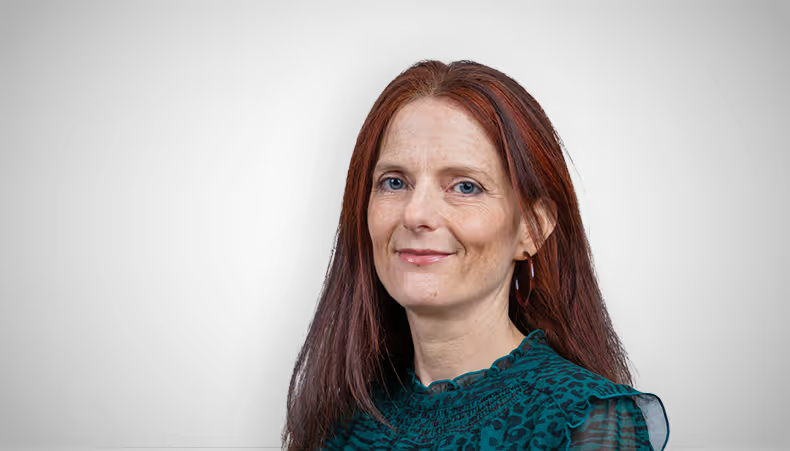
In this episode of ESG in Action, Alex Holsgrove Jones is in conversation with Jess Clarkson, Managing Director at Social Mobility Business Partnership (SMBP).
SMBP is a volunteer-led charity that brings together over 180 employers and provides over one thousand student placements across the UK each year, helping to develop the confidence and employability skills of the next generation.
In this episode, they discuss:
- The challenges that students from low-income backgrounds face when entering the workforce
- The impact that SMBP has already had for thousands of students
- How businesses can help with social mobility initiatives – and the benefits that these bring
- How organisations can get involved with nurturing the next generation of talent
- How listeners can widen opportunity for young people in their local communities
Listen to the episode below, or listen and subscribe on your favourite podcast platform, including Spotify and Apple Podcasts, to make sure you don’t miss an episode.
Jess Clarkson (00:02)
And really to have equal progression, you need leadership buy-in, you need diverse recruitment, and really a top-down and bottom-up momentum and it takes time. It's a cultural shift. So, I think businesses need to be patient, but you've got to get started somewhere.
Alex Holsgrove Jones (00:24)
Welcome to ESG in Action. I’m Alex Holsgrove Jones, Knowledge partner and ESG lead for TLT, and we’re exploring how values-driven leadership, sustainable thinking and inclusive culture are transforming the business landscape. Each episode, I’m joined by a guest who drives ESG progress – from charity leaders to household brands – and they’ll be sharing the tangible impacts of ESG-led decision making.
Today I’m joined by Jess Clarkson, from the Social Mobility Business Partnership, or SMBP.
SMBP is a volunteer led charity that brings together more than 200 employers nationwide to deliver Work Insight and Skills Experience, or ‘WISE’ weeks, alongside mentoring that helps young people from low-income backgrounds access meaningful career pathways.
Here at TLT, we’ve partnered with SMBP for many years, and in the last year we helped to deliver insight days to almost 120 students.
Jess has spent years shaping and scaling the work, and under her leadership the programme has grown dramatically, reaching around a thousand students in 2024 alone. Today we’ll explore what fuels that growth, what challenges still stand in the way of social mobility, and what employers can do to drive real, measurable impact.
Welcome Jess, it’s great to have you on the show.
Jess Clarkson (01:47)
Thank you, I'm very pleased to be here.
Alex Holsgrove Jones (01:49)
So, Jess, you stepped into the Managing Director role after several years leading programme delivery. So let's start at the beginning. What first drew you to SMBP's mission and what is it that still motivates you today?
Jess Clarkson (02:04)
Start with a big question.
Alex Holsgrove Jones (02:06)
Absolutely.
Jess Clarkson (02:04)
Yes, I was first involved actually as a volunteer for SMBP when it launched as a project back in 2014. I recently joined ITV after graduating from university and I remember looking at the programme that was being created by other volunteers at ITV for Year 12 students, you know, visiting ITV, Microsoft, Viacom and BT in just one week. Plus, resilience training day at Harlequins Rugby Club and thinking, wow, what an incredible opportunity for these young people and actually, what if I had had something like this when I was younger? And as someone who attended a state school that had provided no career guidance, the programme really resonated with me. So, in its first year, we delivered one WISE week, as you correctly called it earlier, to 20 students in Year 12 from low income backgrounds in London and then from there, the programme continued to grow momentum and we began to launch programmes in other areas of the UK. We registered as a charity in 2017. And by 2017, I was then still in a volunteer capacity overseeing the operational delivery of WISE weeks for 300 students now across London, Manchester, Birmingham, Leeds, Brighton, Reading and Bristol and I did have to write those all down to make sure I included them all. And this was, as I said, still alongside my day-to-day role at ITV, which involved a fair bit of juggling and I was just spending more and more time on it, but absolutely loving it. And in 2019, when the opportunity presented itself for me to move to the charity as a full-time employee, I absolutely jumped at the opportunity. You could say I took a leap of faith, but to be honest, I didn't have to think about it for all too long.
Alex Holsgrove Jones (03:59)
And you've really had a frontline view of the programme and its growth. What do you think has most accelerated that growth and what have you learned about operating at a national scale?
Jess Clarkson (04:11)
I think, first of all, thinking about the accelerated growth, the sort of three areas that we really focus on at SMBP, which is collaboration, you know, bringing together organisations across public, private and third sector, as well as the professional sports clubs that we work with on our resilience training days and by working together, we are able to create a really high impact, high quality programme for considerably lower resource than it would be for an organisation to create that on their own.
We also like to make sure we are accessible to all and there's a huge amount of willing from organisations, both SMEs and large corporates from across the UK and our job is really to create accessible volunteering opportunities for businesses of all sizes. So, for an SME that might be just delivering an hour to an hour and a half session as part of a WISE day and for corporates, might deliver WISE weeks across their regional offices. So, we tend to think ourselves as the glue bringing everything, all the goodwill together to deliver our programmes. And I suppose the third piece on growth is actually technology. So, we have prided ourselves on our use of technology to streamline our processes and that's for the benefit of the businesses we work with, the students, and then of course the SMBP team. For the businesses we work with, their support of SMBP is quite often delivered alongside their day-to-day work and so, the answer needs to be quite direct and also doable and the planning process achievable.
For the students, they're in a very busy time in year 12, they're making some big decisions, so the communication needs to have absolute clarity and also be accessible to them. So we're very fortunate to have an app which is provided by a company called Fliplet and that provides students with all the key information they need during the week, such as directions to venues, start times, agendas. And then after the week, it provides students with access to our career mentoring platform and live information on career opportunities and obviously for the team using technology really helps remove the need for repetitive administration tasks and allows us to focus our energy elsewhere.
And I suppose for the second part of the question about operational scale and national scale, I think really the answer is we don't know everything and there's no one size fits all. When we are, you know, every region has its own challenges. So, when we are looking to launch a new cluster in a new region, one of the first things we do is to connect with local businesses, councils and charities. Understand the challenges, which may be travel infrastructure, understand where there is appetite to collaborate before we then start planning. So, we really understand the landscape better and that enables us to not be reinventing the wheel because every region is different.
Alex Holsgrove Jones (07:20)
Absolutely. And you've talked there about understanding the challenges and scaling a programme like yours means understanding the barriers that young people face and for people from lower income backgrounds, hurdles like the cost of travel, limited social capital, or simply not feeling they fit in can be really major obstacles. In your experience, what are the toughest challenges that students face and how does SMBP help to address those?
Jess Clarkson (07:51)
So, I think a couple of things to really highlight there is that, you know, for students from low-income backgrounds, they often don't want to be categorised and there's a bit of a stigma around social mobility. And then also the challenge faced by all young people across the UK is that they don't know what they don't know, and they can't aspire to something they cannot see. So, we work incredibly hard to make SMBP visible to students and to encourage applications in the first instance. We are always travelling as a team, speaking to local schools, presenting to students in schools. We also collaborate with a number of charity partners such as Sutton Trust and IntoUniversity to raise awareness with their students about the SMBP programme.
And we have quite a big presence on social media. We encourage a lot of our alumni students to post about the SMBP programme and the impact it's had on them. And also, our ambassador network, who is a particular subgroup of SMBP alumni students who we run monthly master classes for 12 months after the SMBP week and really focus on their presentation skills, their public speaking skills.
We also do financial literacy sessions with them just to sort of help them along and we task them or challenge them, I should say, to then present about their experience with SMBP to the year group below and as I'm sure you can imagine, I can, well, I'm not getting any younger for one, but also I can stand in front of a group of students till I'm blue in the face and tell them why SMBP is a good opportunity for them but I might not have their regional accent and I might not resonate with them. Whereas a young person in the year group above who is saying they've taken part in SMBP is a far more powerful message. So that works really, really well. And then once students secure their placement, we then work to make them feel as prepared and excited about SMBP as possible. So we have an online induction where we run through expectations of the students and how they should be conducting themselves, but equally what the students should expect from the businesses.
We talk about dress code. It's a big stress for these young people. What are they going to wear and what will people think of them? Any boundaries that are in place, you know, not wearing AirPods. Young people walk around with AirPods in 24/7 at the moment and just with no consideration for how it might come across. So, all of these small things, you know, going back to they don't know what they don't know. So for us, it's just making sure we point these out to them.
Then travel is a really big piece of the work that we actually do as well. So, we organise and pay for all of the travel that students need to attend the SMBP programme, just to make sure there is no barrier for them financially in getting to the businesses each day
And then during the week, the Resilience Day, which is delivered in partnership with the sports club, is a really interactive day and it's delivered at the professional sports clubs home ground. And we deliver that on day one because there's a real buzz from the students and an excitement for them to get there and it's also a slightly less alien environment for them. So they feel a bit more confident. can come in their trackies or jeans and t-shirt and that's absolutely fine. And then for the remaining days on the week, we provide quite structured guidance to businesses on the students' requirements, but also their delivery style and how they should be communicating with the student on the day. So, lots of little things, but they're all important And I think together, they all come together to create a real sort of comfortable and trusted programme for the young people so they can really feel that they are included and considered.
Alex Holsgrove Jones (11:53)
I imagine over the years, you've got feedback from the students and you've tailored, things going forward, taking that feedback on board and I think it's so powerful that you have the year group ahead, come talk to them, because you can see the similarities between yourself and somebody who's just a year older and one of the most compelling parts of the story is that impact, isn't it the impact you're seeing and your alumni still talking about it years on. So, you know, what evidence are you seeing that SMBP is changing those outcomes for young people?
Jess Clarkson (12:28)
Yes, it's a good question. People are always asking about the impact and of course it's hugely important and we look at it in the short, mid and long term because there's different things to be achieved at the different stages of the young person's career journey. So short term we are looking for an increase in the students' key employability skills. We work with an organisation called Skills Builder and with them we have created a benchmarking tool within the SMBP app that allows students to benchmark where their employability skills are before the week and then after and so, it gives us a real understanding of any gaps in the skills development during their week and any strengths as well. And generally, across the UK last year, we had a 15 to 20% increase in the students' key employability skills, which was brilliant to see.
We also have a post-programme survey that we send out to students to get a better understanding of their own personal experience on the SMBP and we had 97% of students agree that they have developed their key employability skills. So, a real recognition from them that they are improving.
Alex Holsgrove Jones (13:40)
And that's the confidence point, isn't it? I mean, that's great, going to their confidence.
Jess Clarkson (13:45)
Yes, absolutely, absolutely and on the confidence piece, actually, for us, it's really important that they are confident in choosing their career path after the WISE week, as course that leads on to the midterm piece. And we have 92% of students who are confident in choosing a career path after SMBP.
Midterm, then we're looking at applications for students and thinking about what they might go on to apply for. So 97% of students agree they have a good knowledge of career options available to them and 86% of students have a better understanding of what a professional CV should include and that might sound like a really obvious thing for a young person, but schools are so restricted on resource and actually helping young people to develop professional CVs is not something that Ofsted are going to consider in their analysis. So it's something that's often overlooked, but obviously hugely important for students in the next stage of their career journey.
And then I'm pleased to say long term, so we're looking at students, you know, actually securing placements in higher education or apprenticeships and actually having sustained income. We have many alumni students who come back to us and share their stories. Our volunteer head of alumni, Mohammed, is a fantastic example of this. So he currently is a qualified solicitor at Hogan Lovells. I hope you won't mind me giving him a shout out. But he attended SMBP a long time ago and he always said, I'm going to come back and whatever law firm I end up working with, I will get them on board and he has. So it's wonderful to see that and also all of the other students who get back in touch and I think it's lovely. It really demonstrates how much SMBP means to them when they still are thinking of us two years down the line.
Alex Holsgrove Jones (15:38)
Yeah, absolutely. For employers listening, They might be looking at things like how does partnering with SMBP help with things like employee engagement or building a more inclusive talent pipeline? And if a company is thinking, well, this all sounds great, but where do we start? What's their best first step?
Jess Clarkson (16:00)
I think it's important to say there is a huge amount of research demonstrating the business reason for a diverse and inclusive workforce and although we are a registered charity, what we in our network deliver is not an active charity. The students we work with are a very capable and driven talent pool that any business would be incredibly fortunate to have within their organisation. So really when we're talking to businesses about their own social mobility initiatives, there are three key areas that a business can focus on to increase social mobility in their immediate local community and also their workplace. So, outreach is the first and essentially that's just supporting, as we said, the local community. Of course, I've spoken about the work that we do at SMBP today and this is one example of how business can achieve outreach.
But beyond that, there'll be plenty of other local charities and projects that the organisations can get involved with.
The second area is recruitment. So really having a look at your talent recruitment process and re-evaluating everything with a social mobility lens on it. So, thinking about, you know, where are you advertising your employment opportunities? Is the language accessible? If there are interviews, are they in person? Do they require travel? And if so, would you consider covering the cost of that travel or changing that? There's lots of different changes and considerations you can make to your recruitment processes to make them more inclusive.
And then the last piece, and arguably the most important, is actually around progression, because it's an inclusive workplace that all colleagues should have the ability to progress equally within. And there was a study conducted by KPMG a couple of years ago now that found that individuals from within their own organisation progressed 19% slower if they were from a lower socioeconomic background compared to those from higher socioeconomic background. So, it's just absolutely staggering on that gap. And that is once they have actually, you know, managed to be recruited by the organisation they've got there, but there is still that progression gap. And that really to have equal progression, you need leadership buy-in, you need diverse recruitment, and really a top-down and bottom-up momentum. And it takes time. It's a cultural shift. So, I think businesses need to be patient, but you've got to get started somewhere.
Alex Holsgrove Jones (18:34)
Yeah, and there's so much research showing isn't that a diverse workforce creates a better business, it makes good business sense. So, you know, it's not something that should be disregarded or should be regarded as a nice to have, it's absolutely essential to a resilient business. So, looking ahead to this year's WISE schedule, are there specific regions or sectors where you're keen to expand and where additional partners would make a big difference?
Jess Clarkson (19:06)
Yes, absolutely. We are always looking to expand at SMBP. So, in terms of specific areas of the UK where we're launching or expanding in 2026, we have Liverpool, Bournemouth, Truro, the West Midlands and the North East. So, a nice spread across the UK. But beyond these areas, we are able to offer businesses volunteering opportunities in many other regions across the UK where we have existing programmes. So yeah.
Alex Holsgrove Jones
Get in touch.
Jess Clarkson
Yes, get in touch. Exactly.
Alex Holsgrove Jones (19:43)
I think it's a great initiative and I think for students as well, being able to spend a day in different organisations rather than some work experience, you know, you have to pick one organisation and if on day two, you realise this isn't for me, you've got the rest of the week, and you can possibly get quite a narrow work experience week. With SMBPs programme, there's that variety, isn't there and it really, really exposes students to different organisations that all work in different ways.
So beyond SMBP itself, where do you see the biggest opportunities for cross-sector action on social mobility over the next couple of years?
Jess Clarkson (20:26)
Okay, so I think if I was going to pick one thing, it's got to be the two-week work experience guarantee that the UK government has recently introduced a policy on. It is a very exciting initiative. So, I suppose to give a bit of context on this, currently or previously in the UK, students complete one week of compulsory work experience in year 10. I'm so sure we will all remember having to try and secure that work experience and finding it, probably.
Alex Holsgrove Jones (21:01)
Very difficult, I think.
Jess Clarkson (21:02)
Very difficult to secure it. And if you do manage to secure it, not necessarily an inspirational experience, depending on where you end up going. And in fact, actually, less than 50% of students across the UK do complete this at the moment. So, it's really not enough at all. And there's various reasons for this. for businesses committing to one full week of work experience is a huge undertaking.
Schools simply just do not have the resource to secure placements for their students and so as a result students have to secure these placements themselves and that requires them to rely on their immediate network or their guardians network which will differ student by student.
Alex Holsgrove Jones (21:45)
Well, and even if they do have a network, the age of 14 or 15, a lot of businesses won't be willing to take someone.
Jess Clarkson (21:54)
Exactly, exactly. So it's a real challenge and what the two-week work experience guarantee aims to ensure for all young people and particularly those in underserved areas is that they have access to high quality workplace experiences and ultimately that should reduce inequality and access to opportunities. So, it will guarantee 10 days or 50 hours of high quality work experience for students from the age of in year 7 all the way through to year 11 and this approach offers, you know, flexibility and varied approaches to ensure multiple meaningful interactions with employers and the careers and enterprise company have been doing a huge amount of work to run pilots of this programme across the UK and actually have gained insight from over 40 career hubs across the UK and sort of unsurprisingly, the insight from those is that it's great, it works and we're seeing positive noises.
But actually, there's a real capacity constraint in that schools and employees have limited time and resource, as do staff to coordinate the placements. And also, there's barriers to inclusion because opportunities are still depending heavily on family and social networks, which is disadvantaging some learners.
So we think it's hugely exciting in what it can achieve, but it needs collaboration in every corner of the UK to achieve what it wants to. So, we're having conversations about the SMBP model and how that could potentially be utilised, which is exciting. So, I suppose watch this space.
Alex Holsgrove Jones (23:42)
Great, no, does sound exciting. So, to finish Jess, let's bring it back to those individual actions that can really make a difference, something that everyone listening can aim to do. So, if you could ask our listeners to do one thing to widen opportunity for young people in their communities, what would it be?
Jess Clarkson (24:04)
I am shamelessly just going to say get in touch with SMBP or another local charity, but who supports young people to offer your time. Schools do not have the resource to take your calls, so please don't get in contact with schools directly. Get in touch with a charity who has the connections and the expertise to really sort of use your volunteer time to the maximum impact. So, anyone can get in touch with SMBP via our website, which is SMBP.org.uk and we'd be happy to set up a call and see how we can involve you.
Alex Holsgrove Jones (24:38)
Great Jess, thank you so much for joining us and for sharing such thoughtful insight into the work of SMBP and the wider social mobility landscape. It's really clear that when employers, educators and communities come together, the impact can be really transformative, not only for young people, but for those organisations who are committed to building fairer, more inclusive workplaces. So, thanks for your time, Jess.
Jess Clarkson (25:03)
Thanks, Alex.
Alex Holsgrove Jones (25:05)
And to our listeners, thank you for tuning in. We hope today's conversation with Jess has sparked new ideas about how each of us, through our work, our teams and our communities, can help widen opportunity and support the next generation of talent. If you enjoyed this episode, don't forget to subscribe and share. And until next time, keep driving positive change and putting ESG into action.
Related services

Get in touch






%20%C3%94%C3%87%C3%B4%20790px%20X%20451px%2072ppi21.jpg)
%20%C3%94%C3%87%C3%B4%20790px%20X%20451px%2072ppi%20London.avif)


%20%E2%80%93%20790px%20X%20451px%2072ppi%20LONDON9.jpg)
Related insights

AI in Motion: Balanced algorithms - addressing bias in AI

Why work-related stress is a health and safety issue

From intention to action: ESG tips you can use from our podcast guests

Climate risks and stranded assets: Protecting your property portfolio

Aligning sustainability with opportunity: The business case for biodiversity net gain

How can carbon credits and insetting help you achieve your net-zero targets?

AI in Motion - How to make sustainable AI a reality

ESG as part of investment strategies - What pension trustees need to know

Preparing for change: turning the Employment Rights Bill into social ESG advantage

Employee Ownership - How an EOT can support your ESG agenda

Pub and bar: The growing importance of knowing your supply chain

Climate change risk - Five steps to assess climate risk across your real estate portfolio

Why nature-related risk is the next strategic priority for pension schemes

Climate transition plans - legal opinion on disclosure liabilities for directors and companies

Extended Producer Responsibility - hospitality sector in focus

Limiting construction's environmental footprint using climate conscious drafting



Retail Agility: Navigating the AI frontier in retail




Rethinking Hospitality: Embracing Challenges, Unlocking Growth




TLT advises Eolas Architects on transition to employee ownership

TLT advises The Guinness Partnership on £400 million real estate joint venture

ESG in Action: Nature recovery in action: What Belmont Estate can teach business

ESG in Action: Where capital meets conservation with Rebalance Earth

ESG in Action: How to work well in high-pressure environments with the Mindful Business Charter

ESG in Action: Turning clauses into climate action with The Chancery Lane Project

ESG in Action: From nice to necessary: The business case for wellbeing

ESG in Action: Financing change and changing finance with Triodos Bank

ESG in Action: Working better with Working Families: Flexibility in the workplace

ESG in Action: The future starts at school: Embedding sustainability early with The Green Britain Foundation

ESG in Action: Inside the Government Legal Department’s social mobility agenda

ESG in Action: Climate resilience in real terms: Breaking sustainability silos with Santander

ESG in Action: Hospitality and sustainability working together for future successes

ESG in Action: Beyond returns: Inside the world of responsible investment

ESG in Action: Trailblazing with Ablaze: Helping young people succeed

ESG in Action: Power from the panels: Profit with purpose with Eden Sustainable

ESG in Action: Top-down and bottom-up momentum: The next chapter of social mobility with SMBP

ESG in Action: Balancing the basket with the British Retail Consortium



Community, connection and collaboration - TLT and Forest Green Rovers FC
Placing sustainability at the heart of learning - TLT and the Ministry of Eco Education


A partnership for sustainable action: TLT and Belmont Estate
BNG - TLT and Belmont Estate talk nature positivity

What does the next generation of our cities look like?

